All 8 equipment types Mr. Water LLC designs, installs, repairs, and services
Not sure which one applies to you? Send a few photos and describe the problem through the contact form — with 38 years of experience, Scott can usually point you to the right system before ever coming out.
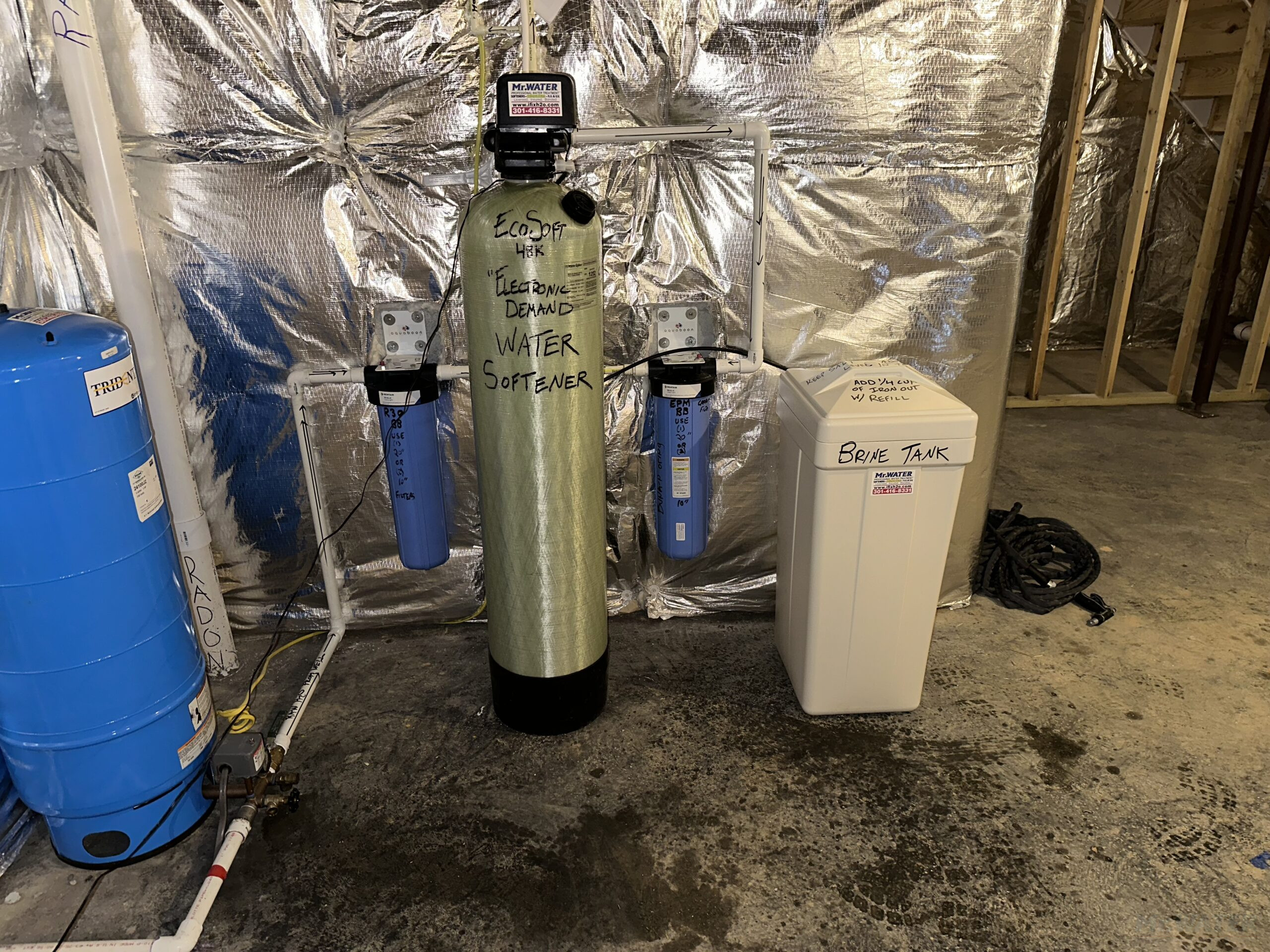
Water softeners use ion exchange to remove hardness minerals from your water. Resin beads inside the tank carry sodium ions, and as hard water flows through, the resin attracts and holds onto calcium, magnesium, iron, and manganese — exchanging them for sodium. Left untreated, these minerals cause scaling in pipes and appliances, reduce soap effectiveness, and leave deposits on fixtures.
When the resin becomes saturated, it's regenerated by flushing with a concentrated brine solution — sodium chloride is standard, though potassium chloride is available for customers on low-sodium diets. Every softener we install is sized to your household's actual water hardness and usage, not a generic average.
Learn more about Water Softeners →
Sulfur water (hydrogen sulfide, H2S) causes the "rotten egg" smell common in well water — it's corrosive to metal fixtures and can be flammable at high concentrations. Iron in well water compounds the problem, staining fixtures and laundry with brown or black discoloration.
Mr. Water LLC's approach is built on two U.S. patents (#9,434,626 and #9,499,417) that combine aeration and softening in a single tank, oxidizing iron and hydrogen sulfide within the resin bed itself — addressing hardness, iron, and sulfur odor in one unit instead of three separate pieces of equipment.
Read the full patent details on our About page →
For homes adding sulfur removal to an existing softener setup, an air injector or air pump introduces tiny air bubbles into the water supply, oxidizing dissolved hydrogen sulfide into elemental sulfur so it can be filtered out. A large 20″ sediment filter captures the resulting particles, and an air separation tank releases the excess air before treated water reaches your plumbing. The same aeration process pre-oxidizes iron, making it easier to remove through your existing softener.
For highly alkaline well water above 8.0 pH, a combined air-and-chlorine injection system is available. Note: homes with a constant-pressure variable-speed well pump may require a more capable air pump (rather than a standard injector) for reliable results — we'll evaluate your well pump setup before recommending equipment.
Learn more about Air Injection Systems →
Low pH well water is corrosive to plumbing fixtures and appliances. An acid neutralizer tank passes acidic water through calcite and magnesium oxide media, which dissolve into the water and raise its pH into a safe range — typically 7 to 8.5 — neutralizing corrosion risk and improving overall water quality.
Learn more about Acid Neutralizers →
UV disinfection safely treats well water that may contain harmful bacteria and viruses, without chemicals. A 254nm UV bulb, quartz sleeve, reaction chamber, and ballast (with an intensity monitor and solenoid valve on some systems) work together — UV light penetrates microorganism cells and disrupts their DNA, rendering them unable to reproduce. Maintenance is straightforward: periodic bulb replacement and quartz sleeve cleaning keep the system performing reliably.
Learn more about UV Disinfection →
Reverse osmosis pushes water under household pressure through a semipermeable membrane that blocks salts, minerals, and contaminants while letting water molecules through. Treated water collects in a dedicated 2-3 gallon holding tank, typically dispensed through its own kitchen faucet — a line can also be run to a refrigerator's ice maker or cold water dispenser. RO remains one of the most reliable ways to get safe, great-tasting drinking water free of contaminants.
Learn more about Reverse Osmosis →
We install heavy duty steel pressure tanks from 34 to 120 gallons, properly sized to your household's water demand for steady pressure and maximum pump life. A failing tank doesn't just hurt water pressure — a bad diaphragm or bladder can introduce bacteria into your water supply and cause short cycling that burns out your well pump prematurely.
Watch for: pressure surges or pulsing at the faucet, rapid pump cycling, a waterlogged tank, rust or corrosion, or bacteria in your water. When we replace a tank, we also inspect and replace the pressure switch, gauge, relief valve, boiler drain, and tank tee as needed — the small parts that keep the whole system running efficiently.
Learn more about Well Tanks →
Sand, silt, clay, and rust act like sandpaper on every moving part in your water system — from softener control valves and RO membranes to faucet cartridges and washing machine inlet screens. We install standard 10″ and 20″ cartridge filters, heavy-duty Big Blue housings for higher flow and sediment loads, automatic backwashing filters for consistently high sediment wells, and spin-down strainers as a first-stage pre-filter for coarse particles.
A properly sized sediment filter is the first line of defense protecting every piece of equipment downstream — and extends the life of your entire water treatment investment.
Learn more about Sediment Filters →
Not sure whether you're dealing with a private well or city water problem — or how your pump even works? About 15% of Americans (roughly 47 million people) get their water from a private well, which the EPA does not regulate the way it regulates the 157,000 public water systems serving the rest of the country. Understanding which system you have, and how it's built, is the first step to treating it correctly.
Learn more about Well Pumps & City Water →
Businesses have different water demands than a single household — higher daily volume, less tolerance for a system going offline, and hardness or iron problems that show up fast in equipment like dish machines, boilers, and laundry systems. We design and service commercial water treatment for restaurants, salons, laundromats, medical and dental offices, apartment buildings, and other businesses across Central Maryland, the West Virginia Panhandle, Northern Virginia, and Southern Pennsylvania.
Commercial systems are sized around your actual usage and water hardness, not a residential average — that can mean larger-capacity softeners, twin-tank alternating systems for businesses that can't be without treated water during regeneration, and service intervals built around your operating hours.
We also repair and service existing commercial equipment regardless of who installed it — control valve rebuilds, resin and media replacement, and tank servicing to keep it running instead of replacing it outright.
Talk to Scott About Your Commercial Water Needs →Send a few photos and describe your water problem — Scott will give you a straight answer on what's actually wrong. If a full on-site water test turns out to be the right move, that's $85–$110.
Send Photos & Get a Straight Answer